Your Patient Journey
From your first call to your final crown — here is exactly what to expect at every step of the dental implant process at Innate Dental Solutions.
The implant process, explained
Free Consultation & 3D Imaging
Your journey begins with a no-cost consultation with Dr. Oz. We take a panoramic X-ray and 3D CBCT scan to map your jaw precisely. You leave with a complete treatment plan and transparent all-inclusive pricing — no surprises later.
Implant Surgery
You will receive sedation — you won't feel a thing. The titanium implant post(s) are precisely placed into the jawbone using our 3D imaging as a guide. Most procedures take 1–3 hours. You go home the same day to rest.
Recovery & Healing
Most patients return to normal activity within 2–5 days. Mild swelling and discomfort are normal and managed with prescription medication. We check in with you regularly during this period.
Osseointegration
Over the next few months, the titanium post fuses with your jawbone in a process called osseointegration. This is what makes implants permanent. Osseointegration is highly dependent on patient compliance — hygiene, overall health, smoking, periodontal (gum) disease, and certain medications all play a role — so we'll guide you on exactly how to protect it. Once confirmed via imaging, we move to the final restoration.
Your Final Crown or Prosthesis
Your custom crown, arch, or prosthesis is placed and adjusted for a perfect fit and bite. You leave with a permanent, natural-looking smile.
For Malo Bridge (All-on-4) patients, steps 2 and 5 are often combined — you may leave treatment day with your final teeth already in place. Patients travelling in for a single stay can often have fixed provisional teeth within 48 hours.
What to expect after surgery
Days 1–3
Rest at home. Mild swelling and soreness are normal. Take prescribed pain medication as directed. Stick to soft foods — yogurt, smoothies, mashed potatoes, eggs.
Days 4–14
Most patients return to work and normal activity. Swelling reduces significantly. Continue soft foods and avoid chewing on the implant side. Gentle brushing resumes.
Week 3 Onward
Fully back to normal. The implant continues to fuse with the bone invisibly below the surface. Follow-up visits confirm healing is progressing perfectly.
Important: Avoid smoking, alcohol, and hard foods for at least 2 weeks post-surgery. These significantly impact implant success rates. Our team will provide full post-op instructions at your appointment.
Why implants are the permanent solution
The Titanium Post
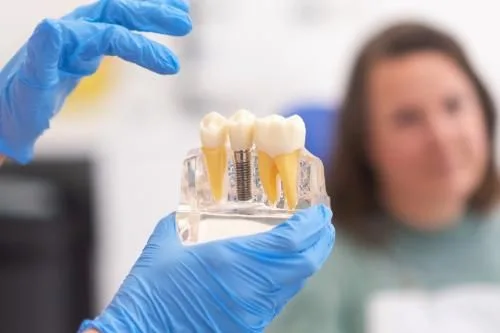
Medical-grade titanium is biocompatible — your body accepts it as natural tissue. Over months it fuses permanently with the jawbone. This is what no denture or bridge can replicate.
The Abutment
A precision connector piece is attached to the post, creating the secure anchor point for your final crown or prosthesis.
The Crown or Prosthesis
Custom-crafted to match your natural teeth in color, shape, and size. The final result is indistinguishable to virtually everyone who meets you.
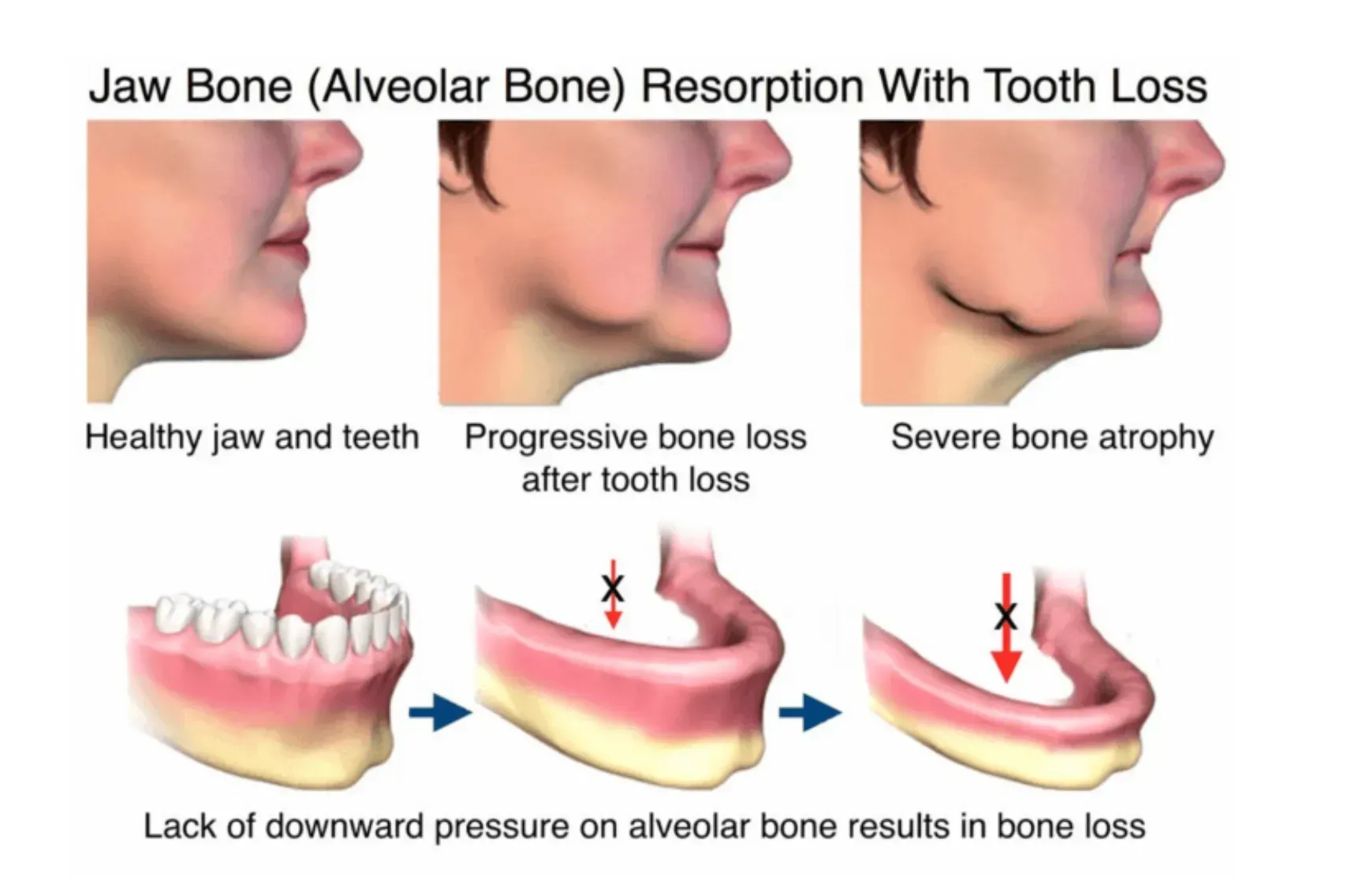
Bone loss without implants: After a tooth is lost, the jawbone begins to shrink within the first year. Dentures and bridges do nothing to stop this — it causes facial sagging and makes fitting dentures increasingly difficult. Implants are the only solution that prevents bone loss entirely.
What the road actually looks like
Most practices show you the dazzling “after” photo and skip the middle. We do it differently. When you understand the phases, the bumps, and the timeline before you start, the process feels reassuring instead of alarming — and nothing that happens along the way catches you by surprise. Rebuilding a full smile is a journey, not a single appointment.
Surgery & Placement
Any remaining teeth are removed, implants are placed into the bone, and you leave with a fixed or removable set of temporary teeth. Swelling and bruising are normal for the first week or two.
Provisional & Healing
The implants quietly fuse to your bone. You wear temporary teeth, eat a softer diet, and we fine-tune your bite over several visits. This is the longest — and most misunderstood — phase.
Your Final Teeth
Once the implants are solid, we craft and fit your final prosthesis — built for the look, strength, and bite we dialed in together. This is the smile you keep. If you are rebuilding both arches, our full-mouth reconstruction page covers the sequence in more detail.
Your temporary teeth are placeholders by design
This is the part patients most often misjudge. The teeth you wear while you heal are working models — intentionally adjustable, not the finished product. Expecting them to look and feel like your final smile is the single biggest source of frustration, so let’s set the record straight.
The bite is dialed in over time
We adjust how your teeth meet across several visits. It may feel “off” at first — that’s expected and fixable.
A softer diet protects healing
Hard, crunchy, and sticky foods can stress healing implants. Eating soft for a few months is part of the plan.
Speech adapts within weeks
A temporary lisp or “full” feeling is common as your tongue learns the new shape. It almost always settles.
Gums shrink as they heal
As swelling resolves, tissue remodels and small gaps or a changing fit can appear. We account for this in the final.
Temporaries can chip or loosen
They’re not as strong as the final. An occasional chip or a loose screw is a quick fix, not a failure.
Looks aren’t final yet
Shade, shape, and contour are perfected in the last phase. Judge the smile at the finish line, not mid-race.
What can go wrong — and what we do about it
Complications are the exception, not the rule, and the large majority of implants integrate beautifully. But “rare” isn’t “never,” so here is the candid version.
An implant doesn’t integrate
Occasionally an implant fails to fuse with the bone. If it happens, it’s usually caught early; the site heals and we replace it — often at no surprise to your final result.
Infection or peri-implantitis
Gum or bone infection around an implant can develop, especially without good hygiene. Caught early, it’s manageable; ignored, it threatens the implant.
Sore spots & tissue changes
Temporaries can rub as your gums shrink. Easy adjustments fix this — tell us early rather than toughing it out.
Numbness, tingling, or sinus issues
Lower implants sit near nerves and upper ones near the sinuses. Temporary altered sensation can occur; lasting issues are uncommon.
Bite that needs repeated tuning
Getting the bite right is iterative. Several adjustment visits during healing are normal — not a sign something is wrong.
Gaps, spaces & food trapping
As tissue settles, small spaces under a fixed bridge can appear. We design the final to minimize them and teach you to clean them.
Additional procedures
Some patients need bone grafting or a sinus lift for a solid foundation. When needed, it adds time — but dramatically improves the long-term result.
Screw loosening or a fractured temporary
Mechanical hiccups happen, particularly in heavy chewers. They’re routine repairs, usually done in a single short visit.
Every item above has a plan behind it. The goal of listing them isn’t to worry you — it’s so that if you ever experience one, you already know it’s a known step, not a catastrophe. Speed of communication is your superpower: the sooner you call us, the smaller the fix.
Your timeline and outcome depend on you
A friend may have healed in three months while yours takes six — or needed two adjustment visits while you need five. That’s not a mistake; it’s biology. These are the biggest factors that tilt a case toward smooth sailing or a longer, more involved road.
| Factor | Tilts toward smoother | May mean a longer road |
|---|---|---|
| Bone quantity & density | Ample, dense bone lets implants anchor firmly right away | Thin or soft bone may need grafting and slower loading |
| Smoking & vaping | Non-smokers heal faster with far lower failure rates | Nicotine starves healing tissue — the #1 controllable risk |
| Diabetes & blood sugar | Well-controlled sugar heals much like anyone else | Uncontrolled sugar slows healing and raises infection risk |
| Gum disease history | Healthy gums give implants a stable home | Past periodontal disease raises peri-implantitis risk |
| Clenching & grinding | Gentle bite forces are kind to healing implants | Heavy grinders need a nightguard and may break temporaries |
| Medications & health | Few medications, good overall health | Blood thinners, steroids, or bone medications need planning |
| Home care & hygiene | Diligent daily cleaning protects the investment for decades | Poor cleaning invites infection around implants |
| Following the plan | Soft diet, kept appointments, prompt calls when something feels off | Skipped visits and hard food early on cause setbacks |
Getting there together
What we promise to do
- ✓ Plan your case in detail before we ever begin
- ✓ Place implants where your bone and bite support them best
- ✓ Adjust your bite carefully across the healing phase
- ✓ Catch and address small issues before they grow
- ✓ Build a final result tuned to how you actually live and chew
What helps us most
- ✓ Stick to the soft-food guidance while you heal
- ✓ Keep your adjustment and check-up appointments
- ✓ Clean as we show you, every single day
- ✓ Wear your nightguard if we recommend one
- ✓ Call early — never sit on something that feels wrong
This guide is general patient education and does not replace personalized advice. Your treatment plan, timeline, risks, and candidacy will be determined by your dentist based on your individual examination, imaging, and health history. Outcomes vary from person to person.
Questions about the process?
Book a free consultation — we'll walk you through every step based on your specific case.
Book Free Consultation